The mesmerizing feeling of warm sun rays leaning down into tropical waters, and breaking back through the water’s vivid facade as it rebounds off the glistening scales of a rare fish provides an experience that stays in one’s memory for a lifetime. I thought I’d share some of the most beautiful species that I know in the waters. There are in the order i consider them the most vibrant and beautiful, since, beauty is, ofcourse, in the eye of the beholder.
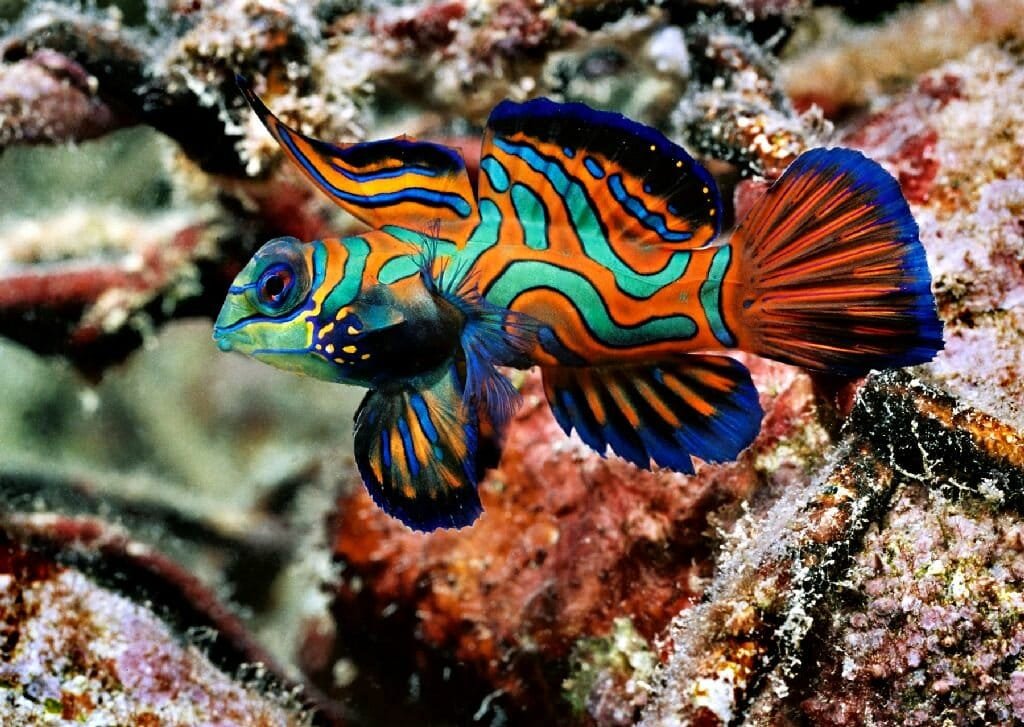
1.Mandarinfish


The Mandarinfish or Mandarin dragonet , is a small, brightly-colored member of the dragonet family, which is popular in the saltwater aquarium trade. The mandarinfish is native to the Pacific, ranging approximately from the Ryukyu Islands south to Australia.
2.Juvenile Emporer Angel Fish


The emperor angelfish, Pomacanthus imperator, is a species of marine angelfish. It is a reef-associated fish, native to the Indian and Pacific Oceans, from the Red Sea to Hawaii and the Austral Islands.
3.Lionfish


A Lionfish is any of several species of venomous marine fish in the genera Pterois, Parapterois, Brachypterois, Ebosia or Dendrochirus, of the family Scorpaenidae. The lionfish is also known as the Turkey Fish, Scorpion or Fire Fish. They are notable for their extremely long and separated spines, and have a generally striped appearance, red, green, navy green, brown, orange, yellow, black, maroon, or white.
4.Clown Trigger Fish


The clown triggerfish, Balistoides conspicillum, is a triggerfish from the order Tetraodontiformes. This reef-associated fish is commonly found in the tropical Indo-Pacific
5.Nudibranch


A nudibranch is a member of what is now a taxonomic clade, and what was previously a suborder, of soft-bodied, shell-less marine opisthobranch gastropod mollusks, which are noted for their often extraordinary colors and striking forms. The clade Nudibranchia is the largest clade within the heterobranchs, with more than 3,000 described species.
6.Symphysodon


Symphysodon are a genus of three species of cichlid freshwater fishes native to the Amazon River basin. Discus are popular as aquarium fish and their aquaculture in several countries in Asia is a major industry.
7.Mantis Shrimp


Mantis shrimp or stomatopods are marine crustaceans, the members of the order Stomatopoda. They are neither shrimp nor mantids, but receive their name purely from the physical resemblance to both the terrestrial praying mantis and the shrimp. They may reach 30 centimetres (12 in) in length, although exceptional cases of up to 38 cm (15 in) have been recorded. The carapace of mantis shrimp covers only the rear part of the head and the first three segments of the thorax. Mantis shrimp appear in a variety of colours, from shades of browns to bright neon colours. Although they are common animals and among the most important predators in many shallow, tropical and sub-tropical marine habitats they are poorly understood as many species spend most of their life tucked away in burrows and holes.
8.Moorish Idol


The moorish idol, Zanclus cornutus, is a small marine fish species, the sole representative of the the Family Zanclidae in order Perciform. A common inhabitant of tropical to subtropical reefs and lagoons, the moorish idol is notable for its wide distribution throughout the Indo-Pacific. A number of butterflyfishes closely resemble the moorish idol.
9.Clownfish


Clownfish or anemonefish are fishes from the subfamily Amphiprioninae in the family Pomacentridae. About twenty-nine species are recognized, one in the genus Premnas, while the remaining are in the genus Amphiprion. In the wild they all form symbiotic mutualisms with sea anemones. Depending on species, clownfish are overall yellow, orange, reddish, or blackish, and many show white bars or patches. The largest reach a length of 18 centimetres (7.1 in), while the smallest barely reach 10 centimetres.
10.Rainbow Parrot Fish


Named Parrot fish because of their calcareous bird-like beaks. Parrot fish use these beaks to crush and eat the small invertebrates that live in coral. Much of the sand and sea floor of coral reefs are actually remains of meals from the parrot fish, they chew the coral, eat the invertebrates and spit out the leftover calcium. In most species, the initial phase is dull red, brown or grey, while the terminal phase is vividly green or blue with bright pink or yellow patches. The remarkably different terminal and initial phases were first described as separate species in several cases, but there are also some species where the phases are similar.